
The name Barbara Kingsolver has become synonymous with books steeped in atmospheric settings, deeply accurate portrayals of class and society, and prose that flows smoothly and settles into the bones with ease and longevity. Kingsolver’s newest novel, Partita, is no different. What is different, though, especially if you come to Kingsolver’s work by way of Demon Copperhead or The Poisonwood Bible, is the slower cadence of this new novel, and how it reveals itself over time and through nuance, much like a Baroque dance suite — an apt comparison as this voice-driven novel is all about music.
The chapters, like the movements of a Baroque dance, are titled Allemande, Toccata, Sarabande, Fugue, and so on, but do not let the classical component dissuade you. Kingsolver writes for everyone, and even includes a playlist at the outset so that you can familiarize yourself with the world along the way.
We start with a phone call that takes Livia Cable, née Bohusz, on a journey through time and memory. A piano teacher in middle Tennessee, Livia lives a quiet life with her husband, Charlie, on their dairy farm. But after hearing from Sigurd, a man she fell madly in love with nearly three decades before, Livia gives herself a week to decide if she wants to come face-to-face once again with the man who ruined her life — or did he? “It’s impossible now to look back on the beginning without also seeing our end,” Livia thinks, “and all the ruin I could have avoided. I’ve wondered if I was seeing the outlines of my own impending failure.”
It is over the course of the week that we toggle back and forth between present-day Livia — a woman who returned home after her life fell apart following not one but two unforeseen tragedies — and 20-year-old Livia — a woman who escaped the clutches of a town who viewed her and her family differently after her brother died by suicide.
In the present, as she counts down the days until she must decide if she can face her past, Livia cleans out her childhood home, where her mother lived alone and hoarded for decades after the death of Livia’s father. We watch Livia sift through the tragic wreckage of a mother whose own failures and let-downs were compounded after her son’s suicide. As Livia explains, “‘Kids are appalled by death, so you end up feeling embarrassed. But it isolated my parents too. Their church friends kept us at arm’s length… We were a poisoned family. His suicide was something we should have prevented, and now we might spread it.’”
From Livia’s present-day discoveries we are taken back to 1989 and to her love affair with Sigurd — a social activist who stole her heart at first sight and opened her eyes to a new, albeit brief, existence before he left. “We started out as beautiful besotted people, keeping our beliefs alive with such small shreds of evidence. It’s all so breakable,” the narrator states.
In the present, therefore, we see Livia unearth secrets and truths withheld that shaped her entire upbringing, while in the past we see the many ways in which she was broken, and how those devastations came to shape her life.
Persistent themes resonate throughout Kingsolver’s story: grief, fear, life and all its nuances, time and its effects, but especially art and music. “Music is made the world over,” the narrator says at one point, “and its makers might use different patterns and instruments, but we’re all the same in the way we’re moved by it… It’s a language we’re born knowing. To be blessed with its full fluency is a treasure.” Revelations in the quiet, patient storyline and the poignant voice of Livia show us that strength is not always inherent but comes from living and doing and learning. And, of course, from art itself, as Livia makes clear: “The point of art is to help you like your life better.”
Through death and loss, heartbreak and restructuring, what’s evident throughout is how even the most broken spirits can reassemble their life into something meaningful and worthwhile: “Surviving in broken parts is not such a bad thing. Probably it’s the ordinary thing, maybe even something to count as lucky.” Eventually, Livia even says, “If I had a painful confession to make, it was that I’d made so much of the idea I wasn’t whole because somebody broke me. Without crediting what a person might make from putting the pieces back together.”
Early in the novel, Livia explains to Sigurd that a partita is “a composition made of a lot of parts with a lot of different moods… the artist’s work is to make them all add up to something that feels whole.” With this in mind, Kingsolver once again builds a revelatory novel around the simplicities and complexities that make up all the layers of life.
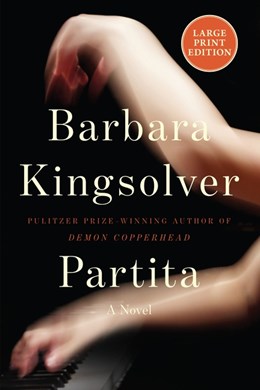
Partita
By Barbara Kingsolver
HarperCollins
Published October 6, 2026


